• Biblical Families is not a dating website. It is a forum to discuss issues relating to marriage and the Bible, and to offer guidance and support, not to find a wife. Click here for more information.

Meat The Trinity Baptism Versus Truth

OttoM

Seasoned Member
Male
Luke 24:47
And that repentance should be preached "In His name" for the forgiveness of sins among all nations; and the beginning will be from Jerusalem.

Every proper baptism recorded in the Bible was done in the "Messiah's name alone." Not in the "name of the Father, the Son, and Holy Spirit." Here are some of the examples (and there are even more not referenced):

Acts 2:38 “Then Peter said unto them, Repent, and be baptized every one of you in the name of Jesus Christ for the remission of sins, and you shall receive the gift of the Holy Ghost.”

Acts 8:12 “But when they believed Philip preaching the things concerning the kingdom of God, and the name of Jesus Christ, they were baptized, both men and women.”

Acts 8:16 “For as yet he was fallen upon none of them: only they were baptized in the name of the Lord Jesus.”

Acts 10:48 “And he commanded them to be baptized in the name of the Lord. Then prayed they him to tarry certain days.”

Acts 19:5 “When they heard this, they were baptized in the name of the Lord Jesus.”

Romans 6:3 “Know you not, that so many of us as were baptized into Jesus Christ were baptized into his death?”

Galatians 3:27 “For as many of you as have been baptized into Christ have put on Christ.”

Colossians 2:12 "For you were buried with Christ when you were baptized. And with him you were raised to new life because you trusted the mighty power of God, who raised Christ from the dead."


---------------------------------------------------------
So where does the trinity formula come from? It comes from one location - Matthew 28:19:
Therefore go and make disciples of all nations, baptizing them in the name of the Father and of the Son and of the Holy Spirit.

In Shem Tob’s Matthew Gospel (the english translation of the gospel of Matthew from Hebrew) - Matthew 28:19 does not say "In the name of the Father, the Son, and Holy Spirit." It says "In my name," which matches up with Luke 24:47 - and the actions of the closet disciples.

So why does the text say "Father, Son, and Holy Spirit." The Catholic church admits it altered/changed the formula (as they have done with many other things):
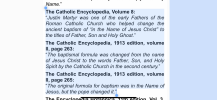
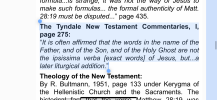
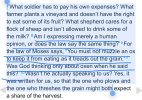
IMG_3474.PNG


IMG_3477.PNG

IMG_3470.jpg

It's clear this was changed by men - specifically the Roman church. They tell you they changed it. The Hebrew Gospel of Matthew (which the Church of Rome kept inside the Vatican), shows the truth. There is no trinity baptism. In Luke 24:47 - with Jesus speaking - he says "In my name." The apostles taught the baptism in the name of the Messiah alone. With Constantine - it was the beginning of the end of truth - and the beginning of leaven.

"Let everything be established by two or three witnesses." "Let God be true and all men liars." "Study thyself to be approved." "Work out your own salvation with great fear and trembling."

Deuteronomy 4:29-31
But from there you will search again for the LORD your God. And if you search for him with all your heart and soul, you will find him. In the distant future, when you are suffering all these things, you will finally return to the LORD your God and listen to what he tells you. 31 For the LORD your God is a merciful God; he will not abandon you or destroy you or forget the solemn covenant he made with your ancestors.

If a child asks their parent - what is the name of the Father, the Son, and the Holy Spirit? Most parents won't have a good answer that is consistent with Scripture. The Son said - "I and the Father are one." "Before Abraham was- I AM." "I have come in my Father's name." We know his name - because the NT tells us his name is Joshua from the Old Testament. Joshua in Hebrew means - God is Salvation. YAH is Salvation. Yahushua the Messiah. (YAH) is God - (Shua) means Salvation. YAH (God) Saves.

Zechariah 12:10
“And I will pour out on the house of David and the inhabitants of Jerusalem a spirit of grace and supplication. They will look on me, the one they have pierced, and they will mourn for him as one mourns for an only child, and grieve bitterly for him as one grieves for a firstborn son.

When has anyone pierced the Almighty? The Gospel of Matthew, Luke, Mark, and John records it.

Proverbs 30:4
Who has gone up to heaven and come down? Whose hands have gathered up the wind? Who has wrapped up the waters in a cloak? Who has established all the ends of the earth? What is his name, and what is the name of his son? Surely you know!
 
Last edited:
Luke 24:47
And that repentance should be preached "In His name" for the forgiveness of sins among all nations; and the beginning will be from Jerusalem.

Every proper baptism recorded in the Bible was done in the "Messiah's name alone." Not in the "name of the Father, the Son, and Holy Spirit." Here are some of the examples (and there are even more not referenced):

Acts 2:38 “Then Peter said unto them, Repent, and be baptized every one of you in the name of Jesus Christ for the remission of sins, and you shall receive the gift of the Holy Ghost.”

Acts 8:12 “But when they believed Philip preaching the things concerning the kingdom of God, and the name of Jesus Christ, they were baptized, both men and women.”

Acts 8:16 “For as yet he was fallen upon none of them: only they were baptized in the name of the Lord Jesus.”

Acts 10:48 “And he commanded them to be baptized in the name of the Lord. Then prayed they him to tarry certain days.”

Acts 19:5 “When they heard this, they were baptized in the name of the Lord Jesus.”

Romans 6:3 “Know you not, that so many of us as were baptized into Jesus Christ were baptized into his death?”

Galatians 3:27 “For as many of you as have been baptized into Christ have put on Christ.”

Colossians 2:12 "For you were buried with Christ when you were baptized. And with him you were raised to new life because you trusted the mighty power of God, who raised Christ from the dead."


---------------------------------------------------------
So where does the trinity formula come from? It comes from one location - Matthew 28:19:
Therefore go and make disciples of all nations, baptizing them in the name of the Father and of the Son and of the Holy Spirit.

In Shem Tob’s Matthew Gospel (the english translation of the gospel of Matthew from Hebrew) - Matthew 28:19 does not say "In the name of the Father, the Son, and Holy Spirit." It says "In my name," which matches up with Luke 24:47 - and the actions of the closet disciples.

So why does the text say "Father, Son, and Holy Spirit." The Catholic church admits it altered/changed the formula (as they have done with many other things):
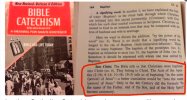
View attachment 11407


View attachment 11408

View attachment 11409

It's clear this was changed by men - specifically the Roman church. They tell you they changed it. The Hebrew Gospel of Matthew (which the Church of Rome kept inside the Vatican), shows the truth. There is no trinity baptism. In Luke 24:47 - with Jesus speaking - he says "In my name." The apostles taught the baptism in the name of the Messiah alone. With Constantine - it was the beginning of the end of truth - and the beginning of leaven.

"Let everything be established by two or three witnesses." "Let God be true and all men liars." "Study thyself to be approved." "Work out your own salvation with great fear and trembling."

Deuteronomy 4:29-31
But from there you will search again for the LORD your God. And if you search for him with all your heart and soul, you will find him. In the distant future, when you are suffering all these things, you will finally return to the LORD your God and listen to what he tells you. 31 For the LORD your God is a merciful God; he will not abandon you or destroy you or forget the solemn covenant he made with your ancestors.

If a child asks their parent - what is the name of the Father, the Son, and the Holy Spirit? Most parents won't have a good answer that is consistent with Scripture. The Son said - "I and the Father are one." "Before Abraham was- I AM." "I have come in my Father's name." We know his name - because the NT tells us his name is Joshua from the Old Testament. Joshua in Hebrew means - God is Salvation. YAH is Salvation. Yahushua the Messiah. (YAH) is God - (Shua) means Salvation. YAH (God) Saves.

Zechariah 12:10
“And I will pour out on the house of David and the inhabitants of Jerusalem a spirit of grace and supplication. They will look on me, the one they have pierced, and they will mourn for him as one mourns for an only child, and grieve bitterly for him as one grieves for a firstborn son.

When has anyone pierced the Almighty? The Gospel of Matthew, Luke, Mark, and John records it.

Proverbs 30:4
Who has gone up to heaven and come down? Whose hands have gathered up the wind? Who has wrapped up the waters in a cloak? Who has established all the ends of the earth? What is his name, and what is the name of his son? Surely you know!
Colossians 2:9
King James Version
9 For in him dwelleth all the fulness of the Godhead bodily.
If the fullness of the Godhead dwelled in Christ bodily, it should be understood that when it is written, in the name of the Father, Son and Spirit, the name is Jesus. I don't think the text is in error but that erroneous doctrine suggests a triune of separate entities VS the biblical three personas of God, Father, Son and Holy Spirit. The only person is Jesus Christ.
 
Colossians 2:9
King James Version
9 For in him dwelleth all the fulness of the Godhead bodily.
If the fullness of the Godhead dwelled in Christ bodily, it should be understood that when it is written, in the name of the Father, Son and Spirit, the name is Jesus. I don't think the text is in error but that erroneous doctrine suggests a triune of separate entities VS the biblical three personas of God, Father, Son and Holy Spirit. The only person is Jesus Christ.
Acts 19:3-7

3 So Paul asked, “Then what baptism did you receive?” “John’s baptism,” they replied. 4 Paul said, “John’s baptism was a baptism of repentance. He told the people to believe in the one coming after him, that is, in Jesus.” 5 On hearing this, they were baptized in the name of the Lord Jesus. 6 When Paul placed his hands on them, the Holy Spirit came on them, and they spoke in tongues 7 There were about twelve men in all.

That passage with Paul implies the use of the name is important. Another passage:

Acts 4:12
Salvation is found in no one else, for there is no other name under heaven given to mankind by which we must be saved.

There is no name found in the phrase - “Father, Son, and the Holy Spirit.”

Furthermore, the great majority of Catholics, Protestants, and Orthodox get baptized in the name of the Father, Son, and Holy Spirit. But so many of them are hostile to the truth. We read that those that are hostile to God’s laws are still in the flesh (Romans 8:7) - which implies - they haven’t been reborn by the Spirit. Certain things like adultery, headship, and biblical polygyny are examples of their rejection of God’s perfect laws/ways/instructions. Which implies that they either do not have the Holy Spirit or they’re actively rejecting the Spirit of Truth (Holy Spirit) - as we see in this passage:

Acts 7:51 NLT
“You stubborn people! You are heathen at heart and deaf to the truth. Must you forever resist the Holy Spirit? That’s what your ancestors did, and so do you!

So how can they have the “Spirit of Truth” if they flat out reject the truth, and in some cases are even hostile to the truth? It doesn’t make sense. The only logical explanation is that they’ve received a counterfeit baptism. I’m not saying that anyone that has been baptized in the name of the Father, Son, and Holy Spirit is not saved. Because with the Creator - all things are possible. I’m saying, however, and I think the fruit is pretty clear - the majority being baptized in that manner have either rejected the Holy Spirit (Spirit of Truth), or never received the Holy Spirit in the first place.
 
Last edited:
What does the phrase, in the name of or, in His name mean when it's used in the Bible? Cheers
 
So why didn’t they change all of the references? Why just one? This doesn’t pass the smell test.
1. Divine intervention. We're told to study ourselves approved, and to test all things. Let everything be established by two or three witnesses. If the Creator allowed all the references to be changed, then how is the prophesied remnant seeking their Creator with all their heart and soul supposed to get to the truth? Because we're supposed to worship in Spirit and Truth. But if that truth has been completely wiped clean - how is that possible? As things stand - there is one reference to "Father, Son, and Holy Spirit." But at least 10 references to "In his Name" regarding the baptism. For me personally, I assumed the baptism is supposed to be done "In his Name." Because I first read a lot of the NT before being fead leaven from the churches. As I grew in faith and knowledge - and was lead to the truth about adultery - I stopped going and listening to places that were teaching lies and deception (to shield myself from further leaven in the early stages of my faith). If they're having trouble getting the mashed potatoes right - then they shouldn't be trusted with the meat.

2. There's too many references of using the Messiah's name alone. Perhaps making changes to every reference would had raised suspicion.

Something I learned just this week - Matthew 28:19 has a lot of baggage:

Catholic Cardinal Joseph Ratzinger:
He makes this confession as to the origin of the chief Trinity text of Matthew 28:19. “The basic form of our (Matthew 28:19 Trinitarian) profession of faith took shape during the course of the second and third centuries in connection with the ceremony of baptism. So far as its place of origin is concerned, the text (Matthew 28:19) came from the city of Rome.” The Trinity baptism and text of Matthew 28:19 therefore did not originate from the original Church that started in Jerusalem around AD 33. It was rather as the evidence proves a later invention of Roman Catholicism completely fabricated. Very few know about these historical facts.

The Jerusalem Bible, a scholarly Catholic work, states:
“It may be that this formula, (Triune Matthew 28:19) so far as the fullness of its expression is concerned, is a reflection of the (Man-made) liturgical usage established later in the primitive (Catholic) community. It will be remembered that Acts speaks of baptizing “in the name of Jesus,”…”

The Catholic Encyclopedia, II, page 263:
The baptismal formula was changed from the name of Jesus Christ to the words Father, Son, and Holy Spirit by the Catholic Church in the second century.”

“The Demonstratio Evangelica” by Eusebius:
Eusebius was the Church historian and Bishop of Caesarea. On page 152 Eusebius quotes the early book of Matthew that he had in his library in Caesarea. According to this eyewitness of an unaltered Book of Matthew that could have been the original book or the first copy of the original of Matthew. Eusebius informs us of Jesus’ actual words to his disciples in the original text of Matthew 28:19: “With one word and voice He said to His disciples: “Go, and make disciples of all nations in My Name, teaching them to observe all things whatsover I have commanded you.” That “Name” is Jesus.

Tom Harpur:
Tom Harpur, former Religion Editor of the Toronto Star in his “For Christ’s sake,” page 103 informs us of these facts: “All but the most conservative scholars agree that at least the latter part of this command [Triune part of Matthew 28:19] was inserted later. The [Trinitarian] formula occurs nowhere else in the New Testament, and we know from the only evidence available [the rest of the New Testament] that the earliest Church did not baptize people using these words (“in the name of the Father, and of the Son, and of the Holy Ghost”) baptism was “into” or “in” the name of Jesus alone. Thus it is argued that the verse originally read “baptizing them in My Name” and then was expanded [changed] to work in the [later Catholic Trinitarian] dogma. In fact, the first view put forward by German critical scholars as well as the Unitarians in the nineteenth century, was stated as the accepted position of mainline scholarship as long ago as 1919, when Peake’s commentary was first published: “The Church of the first days (AD 33) did not observe this world-wide (Trinitarian) commandment, even if they knew it. The command to baptize into the threefold [Trinity] name is a late doctrinal expansion.”
 
Last edited:
What does the phrase, in the name of or, in His name mean when it's used in the Bible? Cheers
I have done entire teachings on precisely that subject; sadly, they'd be banned if I posted the link, but you can find them on my site, reference the parsah, or Torah portion, called, "Chayei Sarah" (the Life of Sarah) - and Genesis chapter 24 in particular.

It is the utter essence, and first and primary template in Scripture, for the "good and faithful servant," and what it means to "come in the name of" the master - in this case, the servant -- UN-NAMED in the entire chapter! -- of his own master, Abraham.

You won't find a better or more complete example in the entire Bible. (And the entire parsha is arguably THE most vital to an understanding of the English "Common Law," from contracts, to 'money of the merchant' (silver) to agency, aka 'power of attorney,' who, by definition, does the will of the principal, in his name.)

In short, one who "comes in the Name of" his Master, as a good and faithful servant, has His Authority to do His will.
 
Friends in Christ,


Your exploration between Trinitarian baptism and the singular invocation of “Jesus’ name” touches the heart of divine order and ecclesial harmony. In The Great Order, I explore how true spiritual order mirrors the eternal order of God, a harmony in unity, a Trinity in perfect symphony.

1. The pattern of divine authority
Matthew 28:19 commands baptism “in the name of the Father, and of the Son, and of the Holy Spirit.” This isn’t mere ritual, it models the cosmic hierarchy and mutual perichoresis of the Godhead. Baptizing “in the name of Jesus” (as seen in Acts) reflects early praxis, yet it does not replace the Trinitarian order implicit in Christ’s directive

2. Order in diversity
God’s true majesty shines in the unity-in-distinction of Father, Son, and Holy Spirit. Just as a well-ordered family embodies distinct roles unified by love, our baptismal invocation recognizes each person of the Trinity, three in one, one in three. Reducing this to a single “name” diminishes the relational harmony revealed in the Gospel.

3. Historical precedents
Consider Ignatius of Antioch (c. AD 110), who explicitly commands baptism “in the name of the Father… Jesus Christ and of the Holy Spirit”. The Didache, Tertullian, and the Nicene council affirmed the fully Trinitarian formula, recognizing its role in preserving theological order.

4. Does “Jesus’ name” suffice?
This question is good. It recalls the early focus on apostles’ practice, Acts records. Yet, this practice was always later recast within the fuller Trinitarian revelation as the Church grew. The invocation of Jesus’ name is not rejected, but it is completed in the majestic triune ordering. Just as the root supports the tree, so Jesus’ name undergirds but does not exhaust the fullness of the vine.

In conclusion
If we seek to return to God's Great Order in liturgy and life, baptism must reflect the eternal order inherent in God. We honor the Triune, not for mere formality, but because it is the very shape of spiritual reality, Father, Son, and Spirit, in harmonious, ineffable unity.

May our hearts and baptisms reflect this divine symmetry.
 
Baptizing “in the name of Jesus” (as seen in Acts) reflects early praxis, yet it does not replace the Trinitarian order implicit in Christ’s directive
Actually, no. The early followers of 'The Way' certainly knew His real Name. There was no one called, or baptized in the name of, 'jesus' for 16 centuries. That name simply did not exist prior to the AKJV, and the introduction of the letter 'j' to the English language around 1600 AD. And even then, only in English.

I am personally persuaded that the 'triune' references are a later, and arguably pagan (Queen of heaven, Tammuz, Ishtar) addition (including the modification to Matthew.) But none of us can "prove" it, and repeating the arguments will prove pointless, no doubt.

This is not, repeat not, a subject I find particularly profitable to debate. I contend (above) that the important issue about coming "in the Name of" YHVH is doing so in His actual Authority, in accord with His Will and His Word. But if it's worth discussing at all, we ought to at least get the right Name as one of the options. At least one of 'em, anyway...
 
Some seem to treat the phrase, In the name of Jesus Christ, or similar, as a magical formula which must be attached to the conclusion of a prayer. The same goes for baptisms or other activities as though adding this phrase will somehow ensure devine acceptance.

If people are not submitted to and acting under Divine Authority, these words mean nothing. It's as Jesus said, These people draw near to Me with their mouth, And honor Me with their lips, But their heart is far from Me.
 
Some seem to treat the phrase, In the name of Jesus Christ, or similar, as a magical formula which must be attached to the conclusion of a prayer. The same goes for baptisms or other activities as though adding this phrase will somehow ensure devine acceptance.

If people are not submitted to and acting under Divine Authority, these words mean nothing. It's as Jesus said, These people draw near to Me with their mouth, And honor Me with their lips, But their heart is far from Me.
1 John 3:24
Those who obey God’s commandments remain in fellowship with him, and he with them.

John 9:31
We know that God doesn’t listen to sinners, but he is ready to hear those who worship him and do his will.

I keep the Creator’s instructions/commandments/torah/law - not for justification - but because I know who died for me - and paid the penalty in the curse of the law. It was YAH’s own Son - the perfect Word made flesh. And he said - “If you love me keep my commandments.” That simple.

Constantine didn’t die for me. I owe no allegiance to him or anyone after him. Constantine said - “Let’s have nothing in common with the detestable Jews.” Well - what happens if the Jews believe in YAH’s commandments - “Thou shall not steal or practice homosexuality?” Because of the wickedness in your heart - should you steal and practice homosexuality? And if the answer is no - then my question is why is it any different for any other commandments? Because the same Creator that said - “Thou shall not steal” - also said - “Remember the (7th) day Sabbath.” The way I see it - whenever a Christian doesn’t agree with YAH’s instructions - just blame it on the Jews. It’s always the Jews that are the scapegoat. As if the Jews wrote the Torah. The one who died for our sins on the stake/tree was the one that wrote it. If someone despises God’s instructions - then your problem is then with your Lord - Savior - Creator - and not the Jews.
 
Last edited:
1. Divine intervention. We're told to study ourselves approved, and to test all things. Let everything be established by two or three witnesses. If the Creator allowed all the references to be changed, then how is the prophesied remnant seeking their Creator with all their heart and soul supposed to get to the truth? Because we're supposed to worship in Spirit and Truth. But if that truth has been completely wiped clean - how is that possible? As things stand - there is one reference to "Father, Son, and Holy Spirit." But at least 10 references to "In his Name" regarding the baptism. For me personally, I assumed the baptism is supposed to be done "In his Name." Because I first read a lot of the NT before being fead leaven from the churches. As I grew in faith and knowledge - and was lead to the truth about adultery - I stopped going and listening to places that were teaching lies and deception (to shield myself from further leaven in the early stages of my faith). If they're having trouble getting the mashed potatoes right - then they shouldn't be trusted with the meat.

2. There's too many references of using the Messiah's name alone. Perhaps making changes to every reference would had raised suspicion.

Something I learned just this week - Matthew 28:19 has a lot of baggage:

Catholic Cardinal Joseph Ratzinger:
He makes this confession as to the origin of the chief Trinity text of Matthew 28:19. “The basic form of our (Matthew 28:19 Trinitarian) profession of faith took shape during the course of the second and third centuries in connection with the ceremony of baptism. So far as its place of origin is concerned, the text (Matthew 28:19) came from the city of Rome.” The Trinity baptism and text of Matthew 28:19 therefore did not originate from the original Church that started in Jerusalem around AD 33. It was rather as the evidence proves a later invention of Roman Catholicism completely fabricated. Very few know about these historical facts.

The Jerusalem Bible, a scholarly Catholic work, states:
“It may be that this formula, (Triune Matthew 28:19) so far as the fullness of its expression is concerned, is a reflection of the (Man-made) liturgical usage established later in the primitive (Catholic) community. It will be remembered that Acts speaks of baptizing “in the name of Jesus,”…”

The Catholic Encyclopedia, II, page 263:
The baptismal formula was changed from the name of Jesus Christ to the words Father, Son, and Holy Spirit by the Catholic Church in the second century.”

“The Demonstratio Evangelica” by Eusebius:
Eusebius was the Church historian and Bishop of Caesarea. On page 152 Eusebius quotes the early book of Matthew that he had in his library in Caesarea. According to this eyewitness of an unaltered Book of Matthew that could have been the original book or the first copy of the original of Matthew. Eusebius informs us of Jesus’ actual words to his disciples in the original text of Matthew 28:19: “With one word and voice He said to His disciples: “Go, and make disciples of all nations in My Name, teaching them to observe all things whatsover I have commanded you.” That “Name” is Jesus.

Tom Harpur:
Tom Harpur, former Religion Editor of the Toronto Star in his “For Christ’s sake,” page 103 informs us of these facts: “All but the most conservative scholars agree that at least the latter part of this command [Triune part of Matthew 28:19] was inserted later. The [Trinitarian] formula occurs nowhere else in the New Testament, and we know from the only evidence available [the rest of the New Testament] that the earliest Church did not baptize people using these words (“in the name of the Father, and of the Son, and of the Holy Ghost”) baptism was “into” or “in” the name of Jesus alone. Thus it is argued that the verse originally read “baptizing them in My Name” and then was expanded [changed] to work in the [later Catholic Trinitarian] dogma. In fact, the first view put forward by German critical scholars as well as the Unitarians in the nineteenth century, was stated as the accepted position of mainline scholarship as long ago as 1919, when Peake’s commentary was first published: “The Church of the first days (AD 33) did not observe this world-wide (Trinitarian) commandment, even if they knew it. The command to baptize into the threefold [Trinity] name is a late doctrinal expansion.”
So God just decided to not protect that one verse? Again, this doesn’t pass the smell test. You’ve manufactured a situation where you have both a reliable scripture and an unreliable scripture all in service of a pet theology.
 
Last edited:
So God just decided to not protect that one verse? Again, this doesn’t pass the smell test. You’ve manufactured a situation where you have both an unreliable scripture and an unreliable scripture all in service of a pet theology.
Luke 24:47 says there is forgiveness of sins “In his Name.” That’s what the disciples were doing - baptizing “In His Name.” Some time later - it was changed to the Matthew 28:19 formula. But in the first century - at least - it was done “In His Name.” Even if the baptism goes back to the original formula used - as Mark pointed out - the name used was different as well. His name has been buried along with a lot of truth - which of course includes things like adultery and marriage. You have to dig and search diligently. Many people go to church every Sunday, and don’t know the biblical definition of adultery. Adultery is like the mashed potatoes - it’s not even the meat. I call it spiritual apathy, because they don’t take the time to truly dig into his Word. Not just the NT - but also the Torah, the writings, and the prophets (2 Timothy 3:16 - All scripture is profitable for training in righteousness).
 
Last edited:
Amen...water baptism is by immersion in the name of Jesus Christ.

Ephesians 4:5 - "One lord, one faith, one baptism."
John 3:5 - In water in the name of Jesus Christ and in Spirit being filled with the Holy Ghost which is Jesus Christ, God Almighty.
Matthew 28:19 - ...baptizing them in the name... the commission
Act 2:38 - ...in the name of Jesus Christ.. the great commission carried out.
 
Luke 24:47 says there is forgiveness of sins “In his Name.” That’s what the disciples were doing - baptizing “In His Name.” Some time later - it was changed to the Matthew 28:19 formula. But in the first century - at least - it was done “In His Name.” Even if the baptism goes back to the original formula used - as Mark pointed out - the name used was different as well. His name has been buried along with a lot of truth - which of course includes things like adultery and marriage. You have to dig and search diligently. Many people go to church every Sunday, and don’t know the biblical definition of adultery. Adultery is like the mashed potatoes - it’s not even the meat. I call it spiritual apathy, because they don’t take the time to truly dig into his Word. Not just the NT - but also the Torah, the writings, and the prophets (2 Timothy 3:16 - All scripture is profitable for training in righteousness).
I missed this response. I’m sorry Otto this is just silly. Have you done any research into Matthew to see how early if would have had to have been changed? Have you out any thought into what it means if God’s Word can be altered by man? Even your own verses don’t back up your claim.
Luke 24:47
And that repentance should be preached "In His name" for the forgiveness of sins among all nations; and the beginning will be from Jerusalem.
Which name is not mentioned in this verse.
Acts 8:12 “But when they believed Philip preaching the things concerning the kingdom of God, and the name of Jesus Christ, they were baptized, both men and women.”
This verse doesn’t say what name they were baptized by. It says they believed Phillip concerning the kingdom of heaven and the name of Jesus Christ and then they were baptized. You misread the verse. In English. Maybe your analysis of how the text was corrupted is unreliable too?
Romans 6:3 “Know you not, that so many of us as were baptized into Jesus Christ were baptized into his death?
This says nothing about what name was used at the ceremony. It says they were baptized into Jesus Christ. That would not have been erected at all if all three names were used.
Galatians 3:27 “For as many of you as have been baptized into Christ have put on Christ.
This says nothing about what name was used at the ceremony.
Colossians 2:12 "For you were buried with Christ when you were baptized. And with him you were raised to new life because you trusted the mighty power of God, who raised Christ from the dead."
Same thing, no reference to what name was used.
Let everything be established by two or three witnesses."
And this is a straight up lie. This only applies to humans in legal court cases, it does not apply to God. That’s why when people use this phrase they never cite the verse or use the whole reference. This is a deceptive technique to throw away portions of scripture someone doesn’t like. Man has to have witnesses. God does not.

You are straying close to denying the divinity of Christ. By attacking so called “trinitarian” teaching you will be led down a path that will lead to the rejection of Christ. You are already claiming the New Testament has been corrupted.

This is a very old pattern even if the actual topic is new. It’s one of the extreme dangers ever present in the Torah movement. We are obsessed with subverting the New Testament to non-authoritative Jewish beliefs.

Based off of the verses you cited, you are not evaluating these ideas critically. Your claim is that early believers were only baptized in the name of Jesus, but you cite a series of verses that do not identify what name was spoken at the baptism. Then you use these non-specific verses to negate a direct command, “go into all the world and baptize in the name of the Father, the Son and the Holy Ghost”.

This is an extreme error and a pretty obvious one. You need to re-examine your conclusions and your entire approach to scripture.
 
Based off of the verses you cited, you are not evaluating these ideas critically. Your claim is that early believers were only baptized in the name of Jesus, but you cite a series of verses that do not identify what name was spoken at the baptism. Then you use these non-specific verses to negate a direct command, “go into all the world and baptize in the name of the Father, the Son and the Holy Ghost”.
Acts 19:3-7

3 So Paul asked, “Then what baptism did you receive?” “John’s baptism,” they replied. 4 Paul said, “John’s baptism was a baptism of repentance. He told the people to believe in the one coming after him, that is, in Jesus.” 5 On hearing this, they were baptized in the name of the Lord Jesus.
 
Acts 19:3-7

3 So Paul asked, “Then what baptism did you receive?” “John’s baptism,” they replied. 4 Paul said, “John’s baptism was a baptism of repentance. He told the people to believe in the one coming after him, that is, in Jesus.” 5 On hearing this, they were baptized in the name of the Lord Jesus.
Otto, that doesn’t preclude the Matthew formulation, which was a direct command of Christ. It is not a description of an event that wasn’t meant to be instructive of theology. It is a direct command of Christ.

You have to invalidate the gospel of Matthew to do away with it. Why? It will reconcile with the other verses you cite. What are you trying to accomplish with this?
 
Acts 19:3-7

3 So Paul asked, “Then what baptism did you receive?” “John’s baptism,” they replied. 4 Paul said, “John’s baptism was a baptism of repentance. He told the people to believe in the one coming after him, that is, in Jesus.” 5 On hearing this, they were baptized in the name of the Lord Jesus.
Here’s what happens next on this road you’re on; you will decide that Matthew is corrupted and will have to be removed from your New Testament canon. Then, having found the super power of editing, you will begin editing away the rest of the gospel in order to achieve equally silly goals. In the end you will have sliced off so much of the New Testament that you will only believe in the “words of Jesus”, the actual quotes allegedly from him. This is sometimes called being a “red letter” believer.

Then you will realize how stupid it is to believe that somehow a corrupted New Testament accurately preserved Jesus’ words and you will reject the whole thing.

Of course you will never apply the Old Testament to the same process or scrutiny. Somehow you will assume God was able to protect that despite His impotence in the face of the apostle’s heresy. This is a very tiresome process to see repeated over and over. It shakes my commitment to Torah keeping.

I have to remind myself that Torah keeping is just a newer movement and we will have to deal with the novelty seekers for a while.
 
Last edited:
Here’s what happens next on this road you’re on; you will decide that Matthew is corrupted and will have to be removed from your New Testament canon.

I have to remind myself that Torah keeping is just a newer movement and we will have to deal with the novelty seekers and silly individuals determined to be deceived for a while.
The Hebrew gospel of Matthew has it preserved.

The apostles taught from the Torah throughout their letters. We know that the “followers of the way” were commended for their zealousness of the Torah through faith in the risen Messiah.

We know that Paul regarded his own words as human opinion, but what’s written in the Torah as the very word of God:

IMG_0761.jpeg


Over time the time religious leaders have been doing violence to the perfect instructions of the Creator - meanwhile - adding their own human tradition/opinion.

But in the future - when Messiah returns to rule on the earth as King - the law he chooses to govern the whole world will be Torah.

So you’re incorrect that the Torah is a new movement. It’s the past, the present, and the future.
 
Back
Top